
A flanged tee is a pipe fitting with three connection ports, where two ports are parallel to each other and the third port is positioned perpendicular or at an angle to them. Its structural design facilitates branching connections in piping systems, enabling fluid to flow smoothly between pipes in different directions. Flanged tees feature flanges welded to all three pipe ends. The tee manufacturing standard is ASME B16.9, while the flange standard is ASME B16.5.
Typically, flanged tees connect to pipelines via flange plates. This connection method uses bolts to tightly secure the flange plates together, with sealing gaskets placed between them to ensure joint integrity and effectively prevent fluid leakage. During operation, fluid enters through one port and, according to system requirements, is distributed through internal passages to the other two ports, enabling functions such as diversion, convergence, or directional change.
To learn more about customized flange, please click
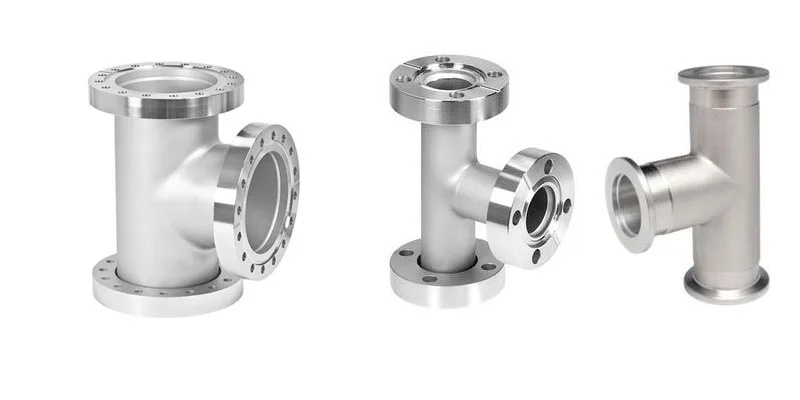
Types of Flanged Tees
Equal Flanged Tees: Equal flanged tees are the most common type, featuring three ports of identical diameter. They are suitable for connecting branch pipes of the same diameter. Utilizing flange connections, they offer not only convenient installation and disassembly but also reliable sealing performance. They are widely used in pipeline systems across industries such as petroleum, chemical processing, and water treatment.
Reducing Flanged Tees: Reducing flanged tees feature one or two ports with differing diameters, commonly used for connecting or transitioning between pipes of varying sizes. They enable rational connections between main and branch lines, ensuring smooth fluid distribution within piping systems. These are frequently found in petrochemical plants and process pipelines.
Lateral Flanged Tees: Lateral Flanged tees feature branch pipes angled less than 90° (e.g., 45°, 60°) relative to the main pipe. This design reduces fluid resistance in applications requiring low flow resistance, such as pipelines transporting high-viscosity media. The angled configuration minimizes impact and vortex formation at branch points, thereby reducing energy loss. It is suitable for piping systems with specific fluid dynamics requirements, such as high flow rates or conditions necessitating reduced impact.
Material & Grades of Flanged Pipe Fittings :
Carbon Steel :
ASTM A105 / A105N,ASTM A350 LF2 / LF3, A694 F42 / 46 / 52 / 56 / 65 / 70
Alloy Steel :
ASTM / ASME A/SA 182 & A 387 F1, F5, F9, F11, F12, F22, F91
Stainless Steel :
ASTM A 182, A 240 F 304, 304L, 304H, 316, 316L, 316Ti, 310, 310S, 321, 321H, 317, 347, 347H, 904L
Duplex & Super Duplex Steel :
ASTM / ASME A/SA 182 F 44, F 45, F51, F 53, F 55, F 60, F 61
Copper Alloy Steel :
ASTM SB 61 , SB62 , SB151 , SB152 UNS No. C 70600 (Cu-Ni 90/10), C 71500 (Cu-Ni 70/30), UNS No. C 10100, 10200, 10300, 10800, 12000, 12200
Nickel Alloy :
ASTM SB564, SB160, SB472, SB162 Nickel 200 (UNS No. N02200), Nickel 201 (UNS No. N02201), Monel 400 (UNS No. N04400), Monel 500 (UNS No. N05500), Inconel 800 (UNS No. N08800), Inconel 825 (UNS No. N08825), Inconel 600 (UNS No. N06600), Inconel 625 (UNS No. N06625), Inconel 601 (UNS No. N06601), Hastelloy C 276 (UNS No.N10276), Alloy 20 (UNS No. N08020)
Flanged Tee Fitting Dimension
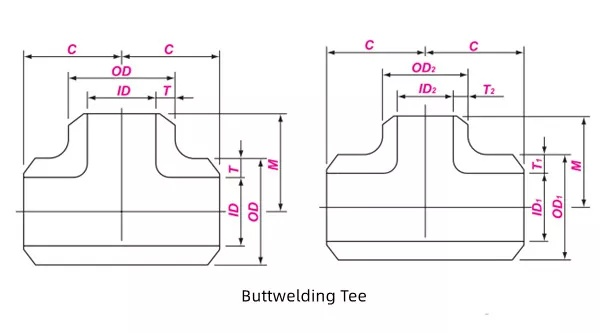
| NPS | O.D. | Center to End | Center to End |
| D | C | M | |
| 1/2 | 21.3 | 25 | 25 |
| 3/4 | 26.7 | 29 | 29 |
| 1 | 33.4 | 38 | 38 |
| 1.1/4 | 42.2 | 48 | 48 |
| 1.1/2 | 48.3 | 57 | 57 |
| 2 | 60.3 | 64 | 64 |
| 2.1/2 | 73 | 76 | 76 |
| 3 | 88.9 | 86 | 86 |
| 3.1/2 | 101.6 | 95 | 95 |
| 4 | 114.3 | 105 | 105 |
| 5 | 141.3 | 124 | 124 |
| 6 | 168.3 | 143 | 143 |
| 8 | 219.1 | 178 | 178 |
| 10 | 273 | 216 | 216 |
| 12 | 323.8 | 254 | 254 |
| 14 | 355.6 | 279 | 279 |
| 16 | 406.4 | 305 | 305 |
| 18 | 457 | 343 | 343 |
| 20 | 508 | 381 | 381 |
| 22 | 559 | 419 | 419 |
| 24 | 610 | 432 | 432 |
| 26 | 660 | 495 | 495 |
| 28 | 711 | 521 | 521 |
| 30 | 762 | 559 | 559 |
| 32 | 813 | 597 | 597 |
| 34 | 864 | 635 | 635 |
| 36 | 914 | 673 | 673 |
| 38 | 965 | 711 | 711 |
| 40 | 1016 | 749 | 749 |
| 42 | 1067 | 762 | 711 |
| 44 | 1118 | 813 | 762 |
| 46 | 1168 | 851 | 800 |
| 48 | 1219 | 889 | 838 |
Flanged Pipe Tees Specification
| Shape Type | Flange | Shape Type | Equal Tee and Reducing Tee |
| Size Range | 1/2″ – 48″/ DN15 – DN1200 | Size Range | 1/2″ – 80″ / DN15 – 2000 |
| Pressure Rating | Class 150, 300, 600, 900, 1500, 2500lb | Thickness Schedule | SCH 10 – SCH 160, XXS |
| Standard | ASME B16.5 | Standard | ANSI / ASME B16.9 |
Flange Types
All three ends of a flanged tee connect to piping via flanges. Common flange types, based on different design standards and application requirements, include:
Weld Neck Flange (WN)
Features a transition cone at the neck for butt welding to piping. Offers high strength and fatigue resistance, suitable for flanged tees in high-temperature, high-pressure, and critical piping systems.
Slip-On Flange (SO)
Pipes are inserted into the flange’s inner diameter for welding. Easy to install, suitable for flanged tees in medium-to-low pressure conditions.
Socket Weld Flange (SW)
Pipes are inserted into the flange’s socket for welding. Compact structure with high strength, commonly used for flanged tees in small-diameter high-pressure pipelines.
Threaded Flange (TH)
Connected via threads without welding. Suitable for flanged tees in hard-to-weld or low-pressure piping systems.
Blind Flange (BL)
Used to seal pipe ends. In certain applications, one end of a flanged tee may employ a blind flange for temporary or permanent sealing.
Lap Joint Flange (LJ)
Used with flanged pipe sections, suitable for pipelines requiring frequent disassembly or with high corrosion resistance requirements.
All Flanged Tee Advantages
1. Exceptional Sealing Performance
Thanks to meticulously designed flange connection structures and premium sealing gaskets, flanged tees maintain outstanding sealing capabilities across diverse operating conditions. Whether conveying high-pressure gases or liquids, or functioning in extreme temperatures, they effectively prevent leakage, ensuring safe and stable system operation.
2. Strong Adaptability
Flange tees offer multiple specifications and materials to suit piping systems with varying diameters, pressure ratings, and medium characteristics. Common materials include carbon steel, stainless steel, and alloy steel, each providing unique performance advantages to meet demands from general industrial applications to specialized corrosive environments.
3. Easy Installation and Maintenance
Compared to other complex pipe fittings, flanged tees feature relatively straightforward installation. Simply align them with the pipes and secure with bolts to complete the connection—no specialized skills or complex tools required. Additionally, they facilitate easy disassembly and replacement during maintenance and repairs, significantly reducing system maintenance costs and downtime.
4. Superior Mechanical Strength
Manufactured from high-strength materials, flanged tees exhibit outstanding mechanical strength and pressure resistance. They withstand both internal pipeline pressures and external environmental stresses, ensuring no deformation, rupture, or damage occurs during prolonged use. This provides a robust foundation for reliable pipeline system operation.
Stainless Steel Flanged Tee, SS 304 & 316
When selecting stainless steel flange tees, material choice is critical. 304 and 316 stainless steel have become two of the most commonly used materials in industrial applications due to their excellent corrosion resistance and mechanical strength, respectively.
304 stainless steel, valued for its favorable cost-performance ratio and broad applicability, is extensively used in food processing, chemical, and pharmaceutical industries. Conversely, 316 stainless steel excels in marine environments and medical equipment due to its superior corrosion resistance. The choice between these grades depends on the specific application scenario and requirements.
Butt weld tees involves more than simply connecting two or three pipes; it requires precise dimensional control, material compatibility, and comprehensive consideration of welding techniques. For both 304 and 316 stainless steel, temperature control during welding is critical—excessively high or low temperatures can compromise weld quality. Additionally, meticulous grinding and inspection are essential post-welding to ensure each weld point can withstand prolonged exposure to high pressure and temperature.
Carbon Steel Flanged Tee Manufacturer
ZIZI is a professional supplier of flanged tees, offering equal-diameter flanged tees, reducing flanged tees, and sloped tees in carbon steel, stainless steel, and alloy steel. Products are strictly manufactured according to international standards such as ASME, DIN, JIS, and GB, covering multiple pressure ratings and size specifications to meet application requirements in industries including petroleum, natural gas, chemical, power generation, and water treatment.
Seamless tees adhere to ASME B16.9 manufacturing standards with ASTM A234 WPB material specifications. Weld neck flanges comply with ASME B16.5 standards using ASTM A105 materials. We provide quality certification documents for flanges and tees, and apply black spray paint to finished products for rust prevention during long-distance sea transport. Products are exported in fumigation-free plywood crates.
We prioritize both product quality and precision, offering third-party inspections (including dimensional checks, material composition analysis, and pressure testing) to ensure every flange and tee meets customer specifications. Through consistent supply capabilities and rigorous quality control, we have established long-term partnerships with numerous domestic and international clients.
If you are seeking a reliable supplier of flanges and tees, please contact us. We are committed to providing high-quality products and comprehensive services.
Customized Flanges—Meeting Specialized Requirements
In many industrial sectors, standard components often fail to fully address specific needs. This is where custom flanged tees become particularly crucial. By collaborating with specialized manufacturers, tees can be tailored to actual operating conditions—customized in size, shape, or even with specialized functions.
For instance, complex chemical plants may require unique flange sealing methods or additional reinforcement measures, demanding manufacturers with extensive production expertise.
How to Select the Right Flanged Tee Manufacturer?
Determine the Operating Environment: Select appropriate materials and pressure ratings based on the fluid medium (corrosiveness, abrasiveness), temperature, and pressure within the pipeline.
Verify Dimensions: Confirm the nominal diameters of the main and branch pipes to determine whether an equal-diameter or reducer tee is required.
Follow Standards: Choose products compliant with relevant national or industry standards, such as ANSI flanged tees, according to project requirements.